Technological Craft · Sculpture and 3D printing

Imprimimos Tradições

:Diverte · Viana do Castelo · 2016–2017

The project

Imprimimos Tradições (We Print Traditions) is an art project that records cultural heritage in physical pieces, modelled digitally and made real through 3D printing. Its first line is dedicated to the regional costumes of Viana do Castelo, considered the most beautiful in Portuguese folk dress.

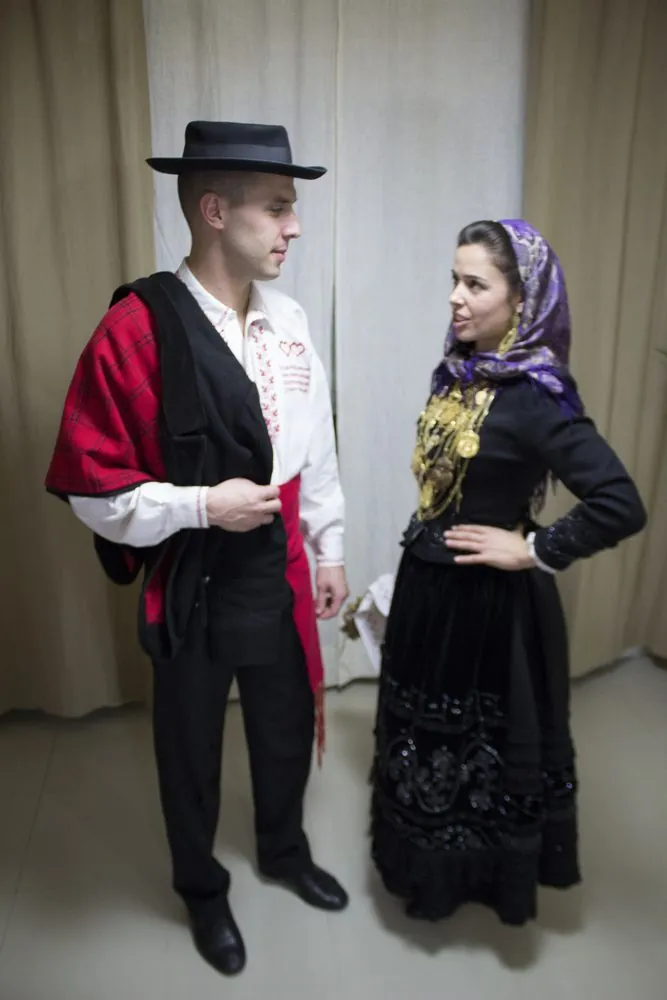
A couple from the Grupo Folclórico de Viana do Castelo wore five costumes, for the mordoma, for Sunday, for festivities, for a wedding and for work, and were 3D scanned in full costume. Each model was then sculpted digitally to bring back the embroidery, the gold and the pleats, 3D printed and finished by hand.

We called it technological craft: the machine prints, but each piece is cleaned, assembled and, in part, painted by hand, which gives it its own identity.

Technical details

Brand
:Diverte
Year
2016, with variations in 2017
Registered work
IGAC, registration no. 3149/2016, “Regional Costumes of Viana do Castelo – Traje à Vianesa”
Pieces
9 statuettes of 5 costumes, as a couple or single
Scales
1:8 (23 cm), 1:10 (18 cm), 1:15 and 1:20
Finish
Printed in more than 30 colours, or painted by hand
Skills
3D scanning, digital sculpture, 3D printing, painting and hand finishing
The five costumes

Each costume exists straight from the printer and painted by hand. Choose the version on each statuette.

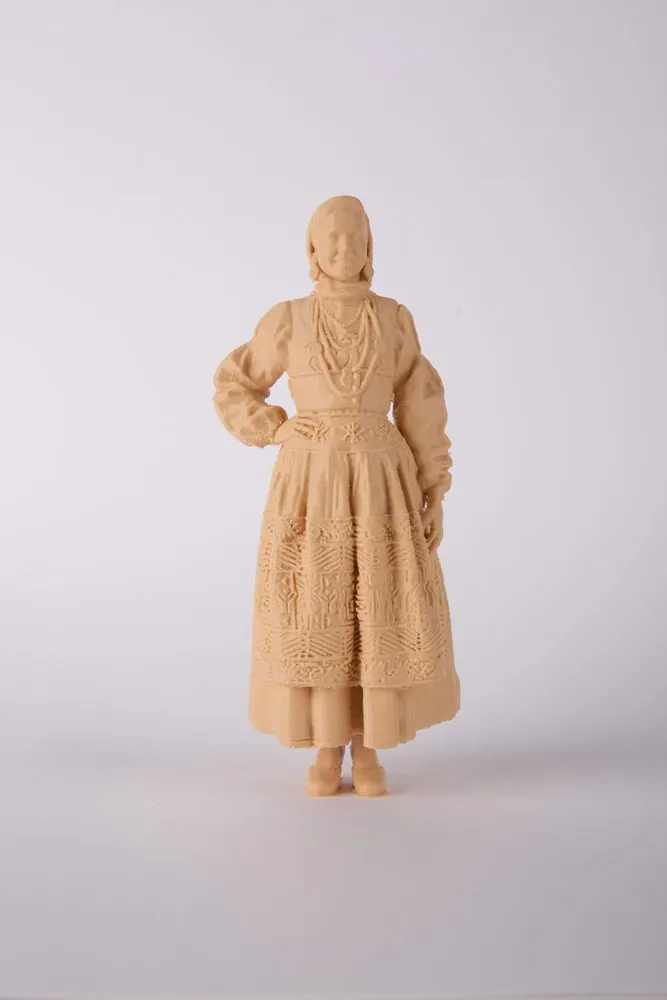
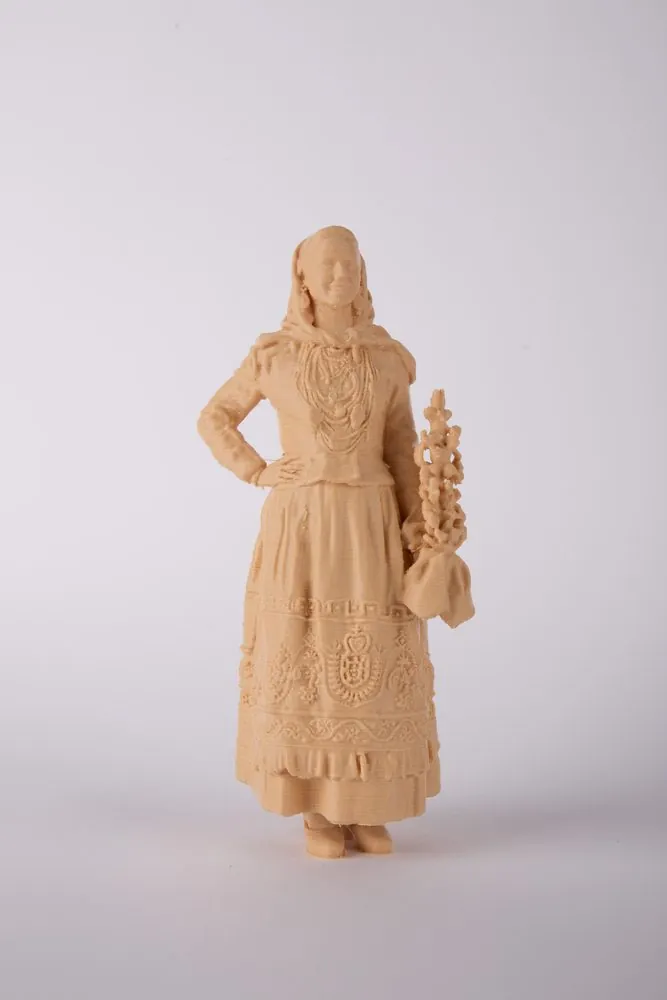
Statuette of the mordoma, with a headscarf, gold on her chest and a palmito in her hand — 3D printed, unpainted

Mordoma

Single · scale 1:8

The mordomas were the young women who organised their villages' festivities. On the day of the procession they walked behind the saint's float in their richest costumes, with gold on their chests. In the statuette she holds the palmito in her left hand.

Statuette of the Sunday costume, with a scarf tied at the back and an embroidered waistcoat, skirt and apron — 3D printed, unpainted

Domingar

Single · scale 1:8

The Sunday costume, for going to mass, to town or to the fair. Simpler than the festive one, it follows naturally from the work costume.

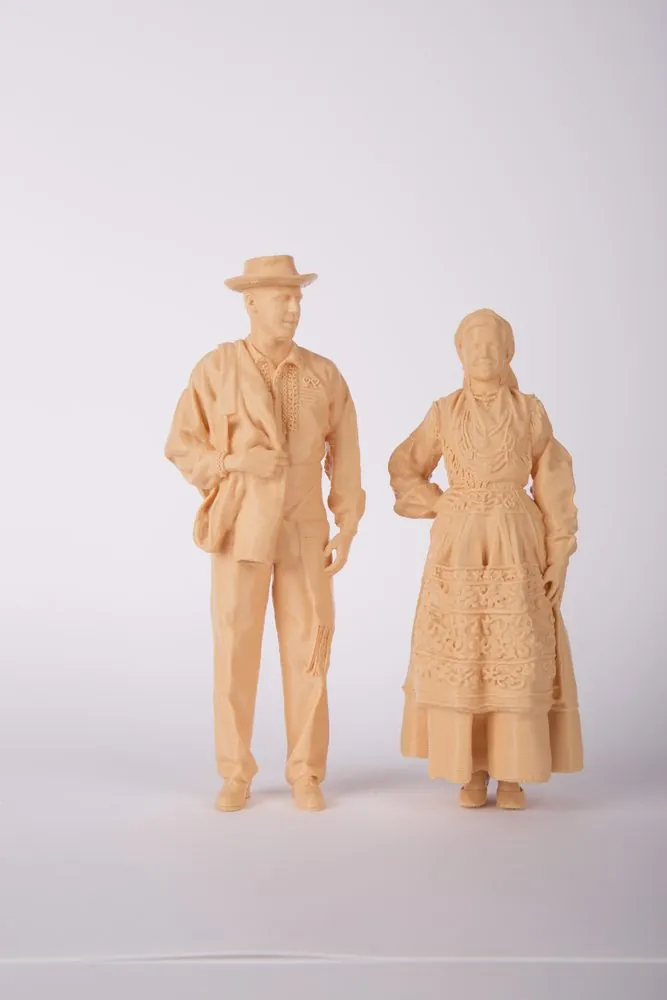
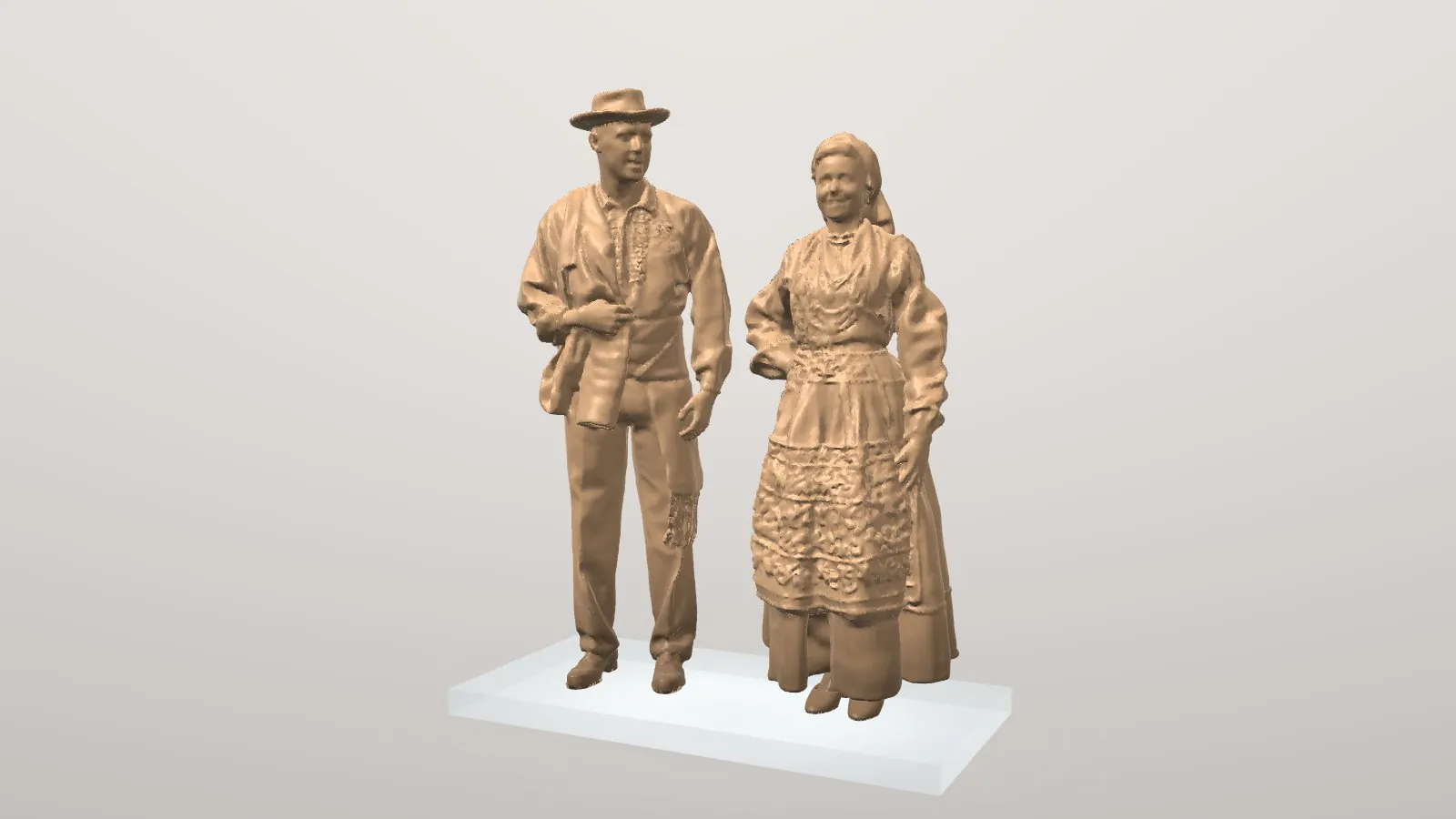
Couple of statuettes in festive costume, side by side — 3D printed, unpainted

Festa

Couple · scale 1:8

She wears the hand embroidery of wool and linen; he wears the cross-stitched shirt, the sash at the waist and the jacket over his shoulder, turned slightly towards her.

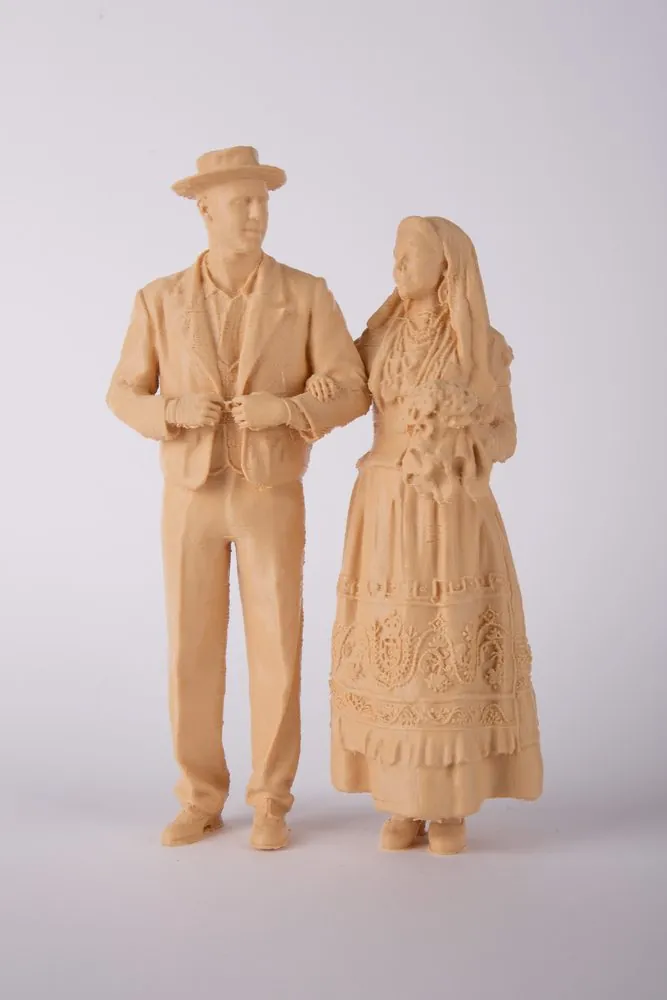
Couple of statuettes in wedding costume, arm in arm — 3D printed, unpainted

Noivos

Couple · scale 1:8

Arm in arm: the bride in black, with glass beads, gold, a tulle veil and orange blossom; the groom in a suit, waistcoat and hat.

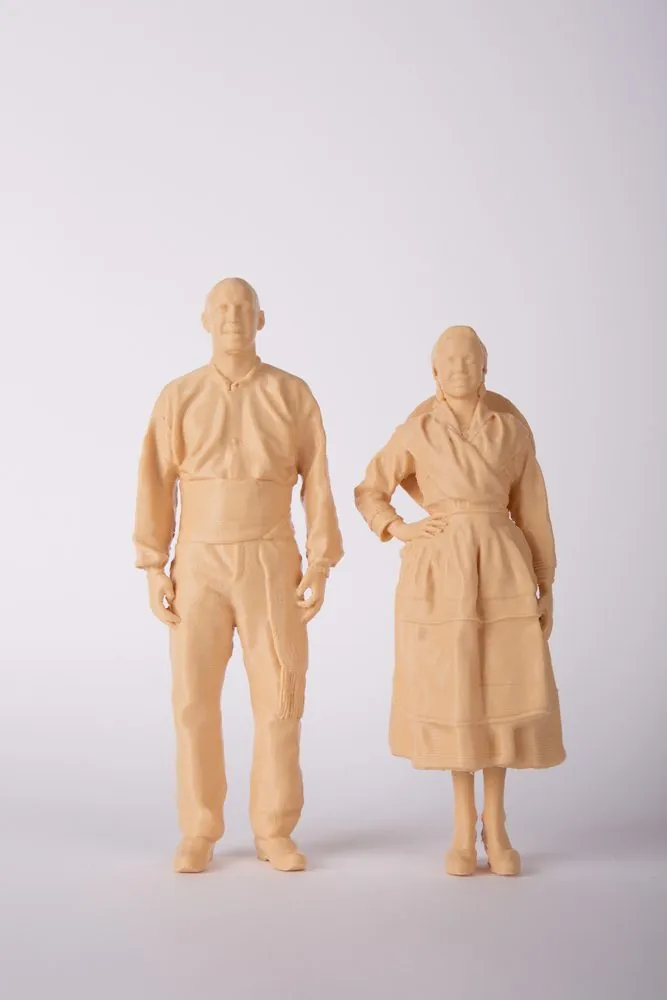
Couple of statuettes in work costume, side by side — 3D printed, unpainted

Trabalho

Couple · scale 1:10

The reapers' costumes, of coarse wool and linen, made for work in the fields and on the hills.

3D model of the couple in festive costume, in the viewerOpen the 3D viewer

Interactive

See the statuettes in 3D

Rotate, zoom in and choose the filament colour. All five costumes and the three 2017 variations are available.

The models shown are reduced, protected versions of the originals: they are for viewing, not for printing.

Open the 3D viewer →

Process

From the person in costume to the painted statuette, in five steps. The whole process was documented.

  1. 1

    Wearing the costume

    A couple from the Grupo Folclórico de Viana do Castelo wore each costume, with every piece and the gold.

  2. 2

    Scanning

    Each model was 3D scanned in full costume, one session per costume.

  3. 3

    Digital sculpture

    The mesh was cleaned and detailed by hand on the computer to recover embroidery, pleats and jewellery.

  4. 4

    Printing

    Each piece is 3D printed layer by layer, and no two prints are the same.

  5. 5

    Finishing and hand painting

    Cleaning, gluing the bases and packing are done by hand. Some pieces are painted by hand by artisans.

Details and behind the scenes

2017 variations

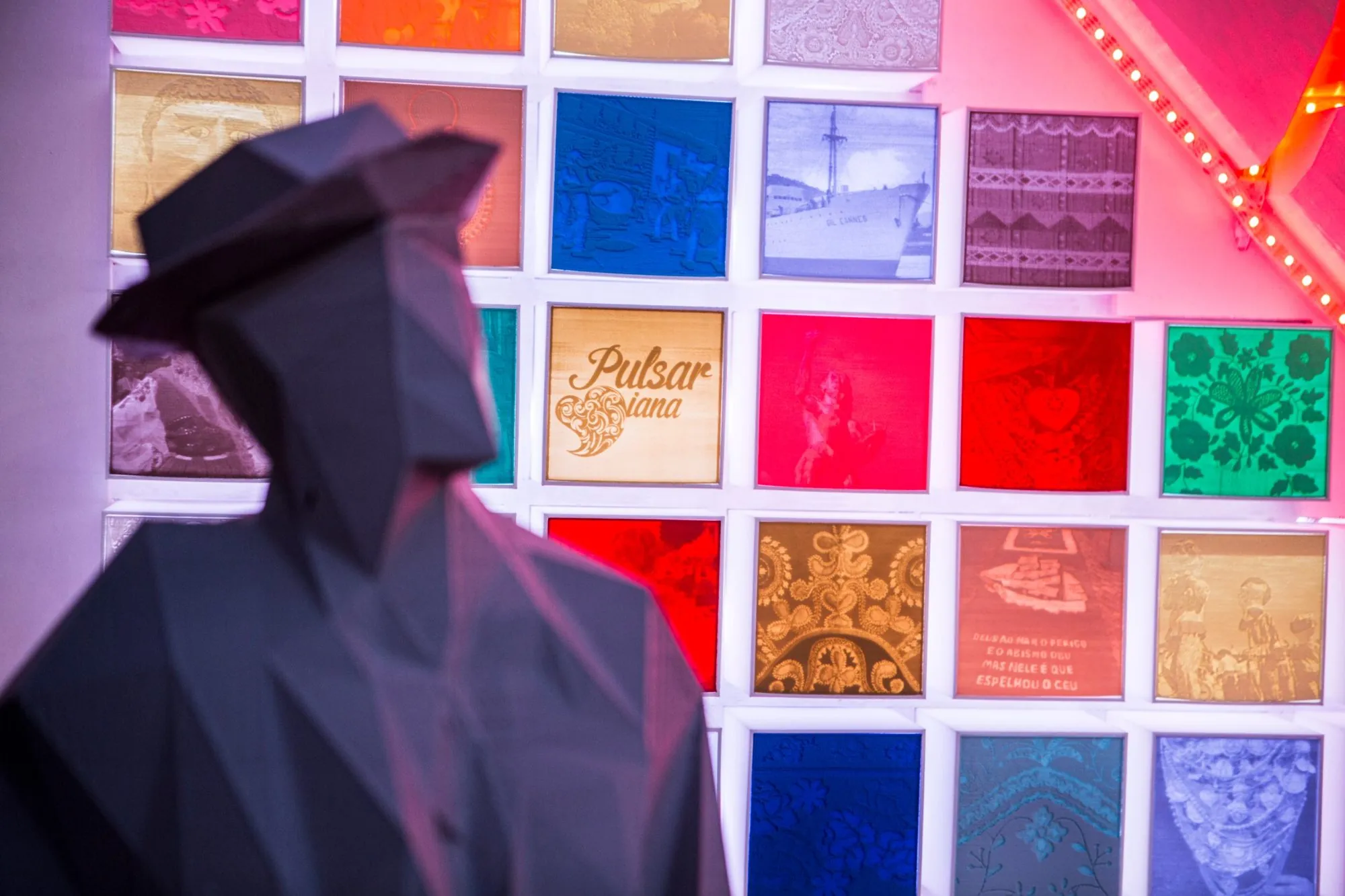
In 2017, the festive costume became the basis for new geometric readings, printed in several colours.

Low-poly

The same pose reduced to flat facets.

Voronoi

The couple opened up into a light, hollow mesh of cells. The 3D viewer also has the wireframe version, with only the edges.

Pins and colours

Small low-poly figures in dozens of colours, shown at craft fairs.

Personalised Edition

We replace the face of one of the statuettes with yours, from a 3D scan made in Viana do Castelo. It cannot be made from photographs.

Your face on one of the statuettes

On the couple costumes we can replace both faces, or only the man's or only the woman's. Mordoma and Domingar are female figures.

  • Choice of costume and size
  • Printed at scale 1:10 or 1:8
  • Acrylic base included

Once created, the piece can be reproduced at scales 1:20, 1:15, 1:10 and 1:8.

How the Personalised Edition works →

Recognition

The statuettes at the Costume Museum, Viana do Castelo.

Costume Museum

The statuettes were part of the exhibition of the Museu do Traje in Viana do Castelo and were sold in its shop.

Registered work

Work registered with the Portuguese General Inspectorate of Cultural Activities (IGAC), registration no. 3149/2016, granted on 25 August 2016.

Hendaye, France

In October 2016, the statuettes were shown at the Hendaye Media Library, in Viana do Castelo's twin town, alongside works by the painter Cipriano Oquiniame and the photographer Diana Mota.

“We want to show people that 3D technology is here and will change everything.”

Pedro Ribeiro, to P3 / Público, 2016

On television

SIC · Juntos à Tarde

2017

Porto Canal · Especial Verão

Report from Viana do Castelo

P3 · Público

2016

Press

  • 2 July 2016

    P3 · Público ↗

    P3 · Público

    Artesanato: a impressão 3D chegou ao traje de Viana do Castelo

  • 27 August 2016

    3DPrint.com ↗

    3DPrint.com

    Traditional Portuguese Dress Preserved in Beautiful 3D Printed Figures from Diverte

  • January 2017

    Lettre municipale de Hendaye, no. 57 ↗

    Lettre municipale de Hendaye, no. 57

    The exhibition of artists from Viana do Castelo at the Hendaye Media Library

  • 16 August 2017

    Semanário Alto Minho, no. 1338 ↗

    Semanário Alto Minho, no. 1338

    Quando o artesanato também é tecnológico (When craft is also technological)

Also covered by: Estação Viana Shopping, Portugal Global (AICEP), 3-d-printer.dk, Fabbing, TiE Eco.

Credits

Project
:Diverte:Diverte
Concept and art direction
Pedro Amaral RibeiroPedro Amaral Ribeiro
3D modelling
Rafael NascimentoRafael Nascimento
3D printing
João CavalheiroJoão Cavalheiro, Pedro Amaral RibeiroPedro Amaral Ribeiro
Photography
João Gigante (PHOLE)João Gigante (PHOLE)
Hand painting
An artisan from CardielosAn artisan from Cardielos, An artist and teacher from Santa Marta de PortuzeloAn artist and teacher from Santa Marta de Portuzelo
Models
A couple from the Grupo Folclórico de Viana do CasteloA couple from the Grupo Folclórico de Viana do Castelo
Next workAmor MinhotoTech Art · Art Installation · Discover the work →